3D anatomy course for students

14 units, 53 lessons and 927 exam-style questions for pre-nursing, pre-med and allied-health students. It opens in the browser with no account.
A 3D atlas of 934 body parts

Each system opens as a model you can turn. Select a bone to name it, isolate it, or hide the body outline around it. This one is the live skeletal atlas.

The skeletal atlas: a 3D skeleton beside the list of its 67 structures

Lessons with labelled 3D figures

Each of the 53 lessons reads like a 50-minute lecture. Its figures are numbered models and diagrams, and Test yourself hides the labels until you name them.

  • 141 labelled diagrams for what a model cannot show
  • 1,245 structures, each with its own card
  • Disorders and key terms in every lesson

Read the heart anatomy lesson

A 3D figure of the heart with the coronary vessels numbered and the circumflex artery selected
FigureCoronary vessels, anterior viewTest yourself
The coronary arteries arise from the ascending aorta and run in the sulci on the surface of the heart.
1Left coronary artery2Anterior interventricular artery 3Circumflex artery4Right coronary artery 5Great cardiac vein6Ascending aorta
Circumflex arteryThe branch of the left coronary artery that follows the coronary sulcus around the left border to the posterior surface of the heart. Supplies the left atrium and the lateral and posterior wall of the left ventricle.

927 questions, each with its explanation. A quiz per lesson, an exam per unit, one final.

Asks questions on the figure

Lab-practical questions highlight one part of a model or diagram. You pick its name from four.

A frontal section of the heart with the mitral valve highlighted
Question 2 / 18Identification
Identify the highlighted structure.
ATricuspid valve
BMitral (bicuspid) valve
CAortic valve

Explains all 927 answers

Right or wrong, each question ends with the reason, so a miss turns into a short review.

Question 15 / 18Function
The pulmonary arteries carry oxygen-rich blood.
TTrue
FFalse
Correct.Arteries are defined by direction, not content. The pulmonary arteries carry oxygen-poor blood away from the right ventricle to the lungs.

Scores questions by kind

Identification, function, mechanism and clinical application are marked apart. 70% completes a lesson.

Result
83%15 of 18 correct. Lesson complete.
Identification7 / 8
Function4 / 5
Mechanism2 / 2
Clinical application1 / 2
Terminology1 / 1
Review
Angiography shows complete occlusion of the anterior interventricular artery. Which region of the heart is most at risk?
Anterior wall of the left ventricle and the interventricular septum. The anterior interventricular artery supplies the anterior walls of both ventricles and most of the septum.

Draws new questions each exam

The skeletal unit exam takes 40 questions from its bank of 100. The final takes 60 across all 14 units.

Skeletal exam · Question 7 / 40Clinical application
A patient struck on the side of the head briefly loses consciousness, recovers, and then becomes drowsy an hour later. Imaging shows a fracture near the junction of the frontal, parietal, temporal and sphenoid bones with blood between the skull and dura. Which vessel is most likely torn?
AInternal carotid artery
BMiddle meningeal artery
CInternal jugular vein
DVertebral artery

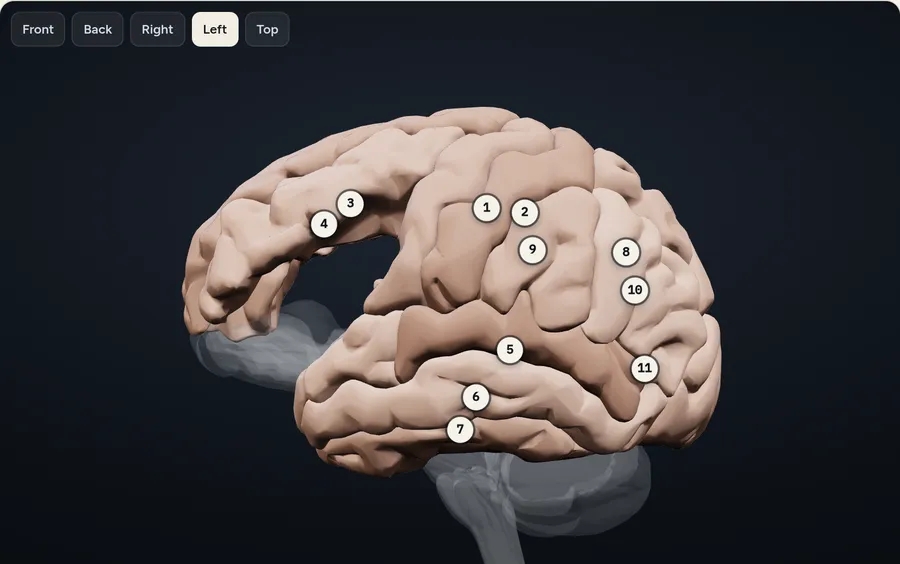
Every bone, muscle, organ, vessel and brain structure is a separate 3D part. Select one to read what it is, isolate it, or hide the layers above it.

The limbic system shown on its own in 3D, its seven structures numbered

14 units, one body system each

In the order a college anatomy course teaches them.

See all 14 units in the syllabus

The muscular atlas: the muscles of the whole body from the front

Questions

The glossary defines 684 terms, each linked to the lesson that teaches it.

Browse the glossary

Filter terms
AcetabulumSkeletal
The socket of the hip bone that receives the head of the femur.
AccommodationSenses
The increase in the curvature of the lens, produced by contraction of the ciliary muscle, that focuses the eye on near objects.
Acid mantleIntegumentary
The slightly acidic film of sweat and sebum on the skin surface that slows bacterial growth.
AcidosisUrinary
An arterial blood pH below 7.35.

Does the course need an account?

No. It opens in the browser and never asks you to sign up.

Where does the course keep my progress?

On your device, in the browser you study in.

How do the course exams work?

Each unit exam is drawn fresh from that unit's question bank. 70% is a pass.

Is every structure shown in 3D?

No. Microanatomy, peripheral nerves and lymph vessels are taught with labelled diagrams.

Where do the 3D models come from?

From BodyParts3D, published by the Database Center for Life Science in Japan.

Is the course medical advice?

No. It is a study aid for students.